Use cases · September 1, 2026
AI calling for agencies: follow up your clients' leads and prove the results
Your ads generate leads, but clients are slow to call them. Here is how agencies can add AI follow-up as a service, with one agent per client.

AI calling for agencies solves a problem you probably already recognise: you generate leads for a client, and the client wastes them. Calls are returned the next day, nobody follows up after the first miss, and the client blames lead quality. By adding an AI voice agent that calls each lead within minutes, qualifies it and books a meeting, you improve the thing the client actually cares about, which is appointments.
The agency problem: leads are not the end of the job
Most performance and lead generation agencies are measured on cost per lead. Clients are measured on closed work. Between the two is a gap where leads decay.
Typical symptoms:
- Reports show healthy lead volume, but the client says the leads are poor.
- Calls to leads happen once, in business hours, a day later.
- Nobody tracks how many leads were reached at all.
- Contract renewals depend on a relationship that rests on an argument about lead quality.
Moving up the funnel from leads to booked appointments changes the conversation. It also gives you data to show what happened to every lead.
What the service looks like
A basic follow-up service has four parts:
- Intake. New leads from forms, ads or landing pages are sent to the AI follow-up campaign. On Pro, webhooks, the API and automations help connect lead sources.
- Call. An agent calls within minutes, within allowed hours, introduces itself as an AI assistant calling for the client, and qualifies the lead.
- Booking. It books a call or visit in the client's Google Calendar, or transfers hot calls live to the client's team.
- Reporting. You review summaries, transcripts and outcomes, and report booked appointments and reached rates to the client.
You can read more about why speed matters in speed to lead and AI calling.
Running multiple clients on the Pro plan
An agency needs separation between clients. On the Pro plan you get unlimited agents, phone numbers, campaigns and contacts, plus webhooks, API access, insights and priority support. In practice:
- One agent per client, each with its own prompt, voice and knowledge base.
- One phone number per client, so caller ID matches the brand, if the client agrees.
- One campaign per client and lead source, so you can see performance by channel.
- Insights to compare reached, qualified and booked rates across clients.
The Pro plan includes 20,000 minutes a month, shared across your use. Phone-number rental and AI usage are billed by the providers, not by Purple Voice, so factor those into your pricing.
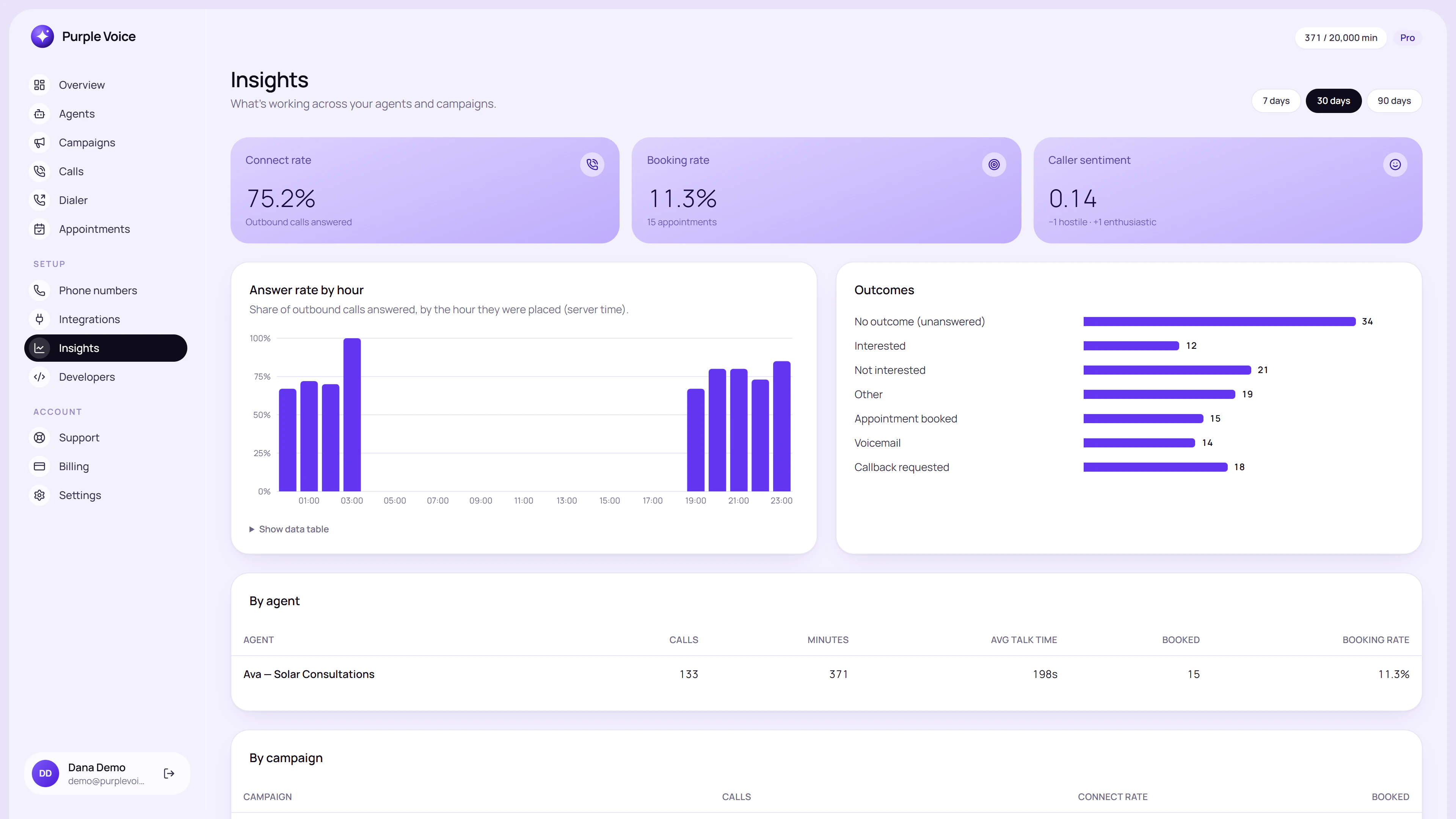 The Insights page, where agencies can compare reach and outcomes across campaigns.
Onboarding a client: what you need
A clean onboarding saves headaches. Collect:
| Item | Why |
|---|---|
| Services, areas served, hours | Knowledge base |
| Qualification criteria | Prompt goals and question list |
| Pricing information they are happy to share | Avoids invented numbers |
| Calendar access | Booking |
| Transfer phone number and hours | Hot call handling |
| Lead source and consent wording | Compliance |
| Objections they hear often | Objection library |
Then use the guide on how to write an AI voice agent prompt to turn that brief into an agent. Test it on your own phone before letting it near the client's leads. Clients forgive many things, but not a wrong price quoted to their customers.
Pricing the service
You have options. None is universally right.
- Monthly retainer. Predictable, simple. Works when volume is stable.
- Setup plus monthly. Covers the effort of building the agent and knowledge base, then ongoing tuning.
- Per booked appointment. Aligns incentives, but you carry risk if lead quality drops or the client is slow to honour appointments.
- Bundled into the lead generation fee. Easiest to sell if you already run the ads.
Work out your cost base: Purple Voice plan, phone numbers, AI usage billed by providers, and the time you spend reviewing transcripts. Do not forget the review time. Someone has to read calls and tune prompts weekly.
A worked illustration, labelled as such: suppose a client receives 200 leads a month, and the follow-up service reaches half of them and books 20 appointments. If the client previously booked 8 from the same leads by manual follow-up, the difference is 12 extra appointments. Your report shows that, plus transcripts as evidence. The numbers here are made up. Use your own data.
Reporting that clients actually read
Keep reports short. A one-page monthly summary can include:
- Leads received.
- Leads reached (spoken to).
- Qualified.
- Appointments booked and held.
- Top three reasons leads did not convert, from transcript summaries.
- Recommended changes, such as new calling hours or an updated offer.
The third item is where you earn your fee. Transcripts reveal what leads think of the offer, the landing page and the price, which your ad data never shows. See AI calling metrics that matter for definitions.
Compliance in a multi-party setup
When you call leads for a client, responsibility is shared, and agreements should say who does what. Decide:
- Who holds the consent evidence for each lead.
- Who handles do-not-call and opt-out requests, and how fast.
- Which countries and states you will call into.
- Who answers a complaint from a lead.
Rules differ by country and change over time. This is general information, not legal advice, so ask a lawyer to review your contract and process. For background, see is AI cold calling legal and do-not-call lists and dialer hygiene. Always disclose that the agent is an AI.
When it does not suit a client
- Clients with a handful of very high-value leads a month, who want to call personally.
- Clients whose lead sources lack consent for phone contact.
- Industries with heavy regulation on advice, unless a human handles anything advisory.
Avoiding common agency pitfalls
Three problems come up repeatedly. First, promising outcomes you do not control: you can commit to calling every lead quickly, but not to the client's close rate. Second, letting prompts drift: keep each client's prompt in a version note so you know what changed when results shift. Third, forgetting the client's own team: if their staff do not answer transferred calls or honour booked slots, the best agent in the world will not save the result. Agree service levels on their side in writing.
Try it
Pick one client with steady lead volume and a slow follow-up habit, and run a four-week pilot. The Purple Voice Free plan lets you build and test one agent with no card, and Pro supports many clients under one account. Start at voice.purplerocket.co and compare plans on the pricing page.
Frequently asked questions
How can marketing agencies use AI calling?
Agencies can add lead follow-up as a service: an AI agent calls each client's new leads within minutes, qualifies them and books appointments. It improves the results of the campaigns you run, and gives you booked meetings to point to.
Can one account run separate agents for different clients?
Yes, on the Pro plan, which includes unlimited agents, numbers, campaigns and contacts. Each client gets its own agent, prompt, knowledge base and phone number.
Can an agency white-label AI calling?
Purple Voice is not a white-label reseller product. You can run agents for clients under your own service and present results in your own reports. Be clear with clients about the tools you use.
How do agencies price an AI follow-up service?
Common options are a monthly retainer, a setup fee plus monthly fee, or a fee per booked appointment. Work out your costs first, including Purple Voice plan costs, phone numbers and AI usage billed by the providers.
What does the agency need from the client?
Lead source access, a clear qualification brief, calendar access, a knowledge base with accurate service and pricing information, a transfer number, and confirmation that the client has consent to contact leads.
Who is responsible for compliance when an agency calls client leads?
Both parties have obligations, and they vary by country. Agree in writing who holds consent records and who handles opt-outs. This is general information, not legal advice, so check the rules for each market.
- agencies
- client-work
- lead-follow-up
- pro-plan