Use cases · August 11, 2026
AI calling for insurance agencies: quote follow-ups and renewal calls
Quotes go unanswered and renewals slip. Here is how an AI voice agent handles the repetitive calls while licensed staff keep advice and sales.

AI calling for insurance is most useful on the repetitive, time-bound calls: following up a quote request, reminding someone their policy renews next month, and booking a review with a licensed adviser. It is not a substitute for advice. Selling and recommending cover is a regulated job, so the sensible setup keeps the AI on qualification and scheduling, and hands anything that sounds like advice to a person.
Where insurance teams lose leads and renewals
Insurance has a particular shape. Leads are expensive to acquire, quotes are easy to ignore, and renewals arrive on a fixed date whether your team is ready or not.
Common leaks in an agency or brokerage:
- A person requests a quote online and no one calls for two days.
- The quote goes out by email and sits unread.
- Renewal reminders are sent in a batch and not followed up.
- Advisers spend mornings making "just checking in" calls that rarely lead anywhere.
These are good targets for automation because each call has a clear, narrow goal.
Use case 1: quote follow-up calls
After a quote is sent, an agent can phone and run a short, friendly check-in. A reasonable flow:
- Introduce itself as an AI assistant calling for your agency.
- Confirm they requested a quote and that they received it.
- Ask if they have questions the team can answer, and answer basic ones from the knowledge base, such as how to pay or how to contact the claims line.
- Ask where they are in the decision: comparing, ready to go ahead, or not interested.
- Offer to book a call with an adviser if they want to proceed or need detail.
The key discipline is what the agent does not do. It should not explain exclusions, compare to a competitor's quote or suggest changes to cover. Write that into the prompt as a firm guardrail. Our guide to writing an AI voice agent prompt covers how to phrase guardrails so they hold up in a real call.
Use case 2: renewal calls
Renewals are where retention is won. A renewal call can:
- Confirm the policyholder still lives at the address or still runs the same business.
- Ask whether anything has changed, such as a new vehicle, an extension or a new driver.
- Flag that the renewal date is approaching.
- Book a review call for anyone whose circumstances have changed or who wants to shop around.
Because these calls are to existing customers, the tone is different from a cold call. The prompt should use the customer's name, mention their policy type in general terms, and keep the call under two minutes. Anyone who says something that suggests a change in risk, such as "we have just had a baby" or "I started a side business", should be flagged for a human and not processed further by the AI.
Use case 3: inbound after-hours and overflow
An agent can also pick up inbound calls out of hours. It can take details for a quote request, answer questions about opening times and claims contact numbers, and book a callback. Do not let it take claim notifications unless you have designed that flow carefully with your compliance team. A first notice of loss is sensitive, and mistakes are costly.
What to ask in qualification
A short set of qualifying questions helps your advisers prioritise. For a personal-lines lead you might gather:
| Detail | Why it helps |
|---|---|
| Type of cover | Routes to the right adviser |
| Current renewal date | Tells you how urgent the lead is |
| Reason for looking | Price, service, a life change |
| Preferred contact time | Improves your next call |
| Whether they want a human call | Respects preference |
Resist the urge to collect full risk details by AI. Those are better handled by a licensed adviser using your underwriting forms. For more on structuring questions, read AI lead qualification calls.
What to log and keep
After each call, you should have:
- A summary of what was said, in a few lines.
- A transcript and, if you record, the recording.
- The outcome: booked, call back later, not interested, do not call.
- A note of any statement that needs human review.
Purple Voice stores call transcripts, AI summaries and recordings on the Calls page, and can send summaries by email or webhook into your CRM on the Pro plan. The point is to produce a trail that a compliance review can follow. See AI call summaries and CRM notes for what to log.
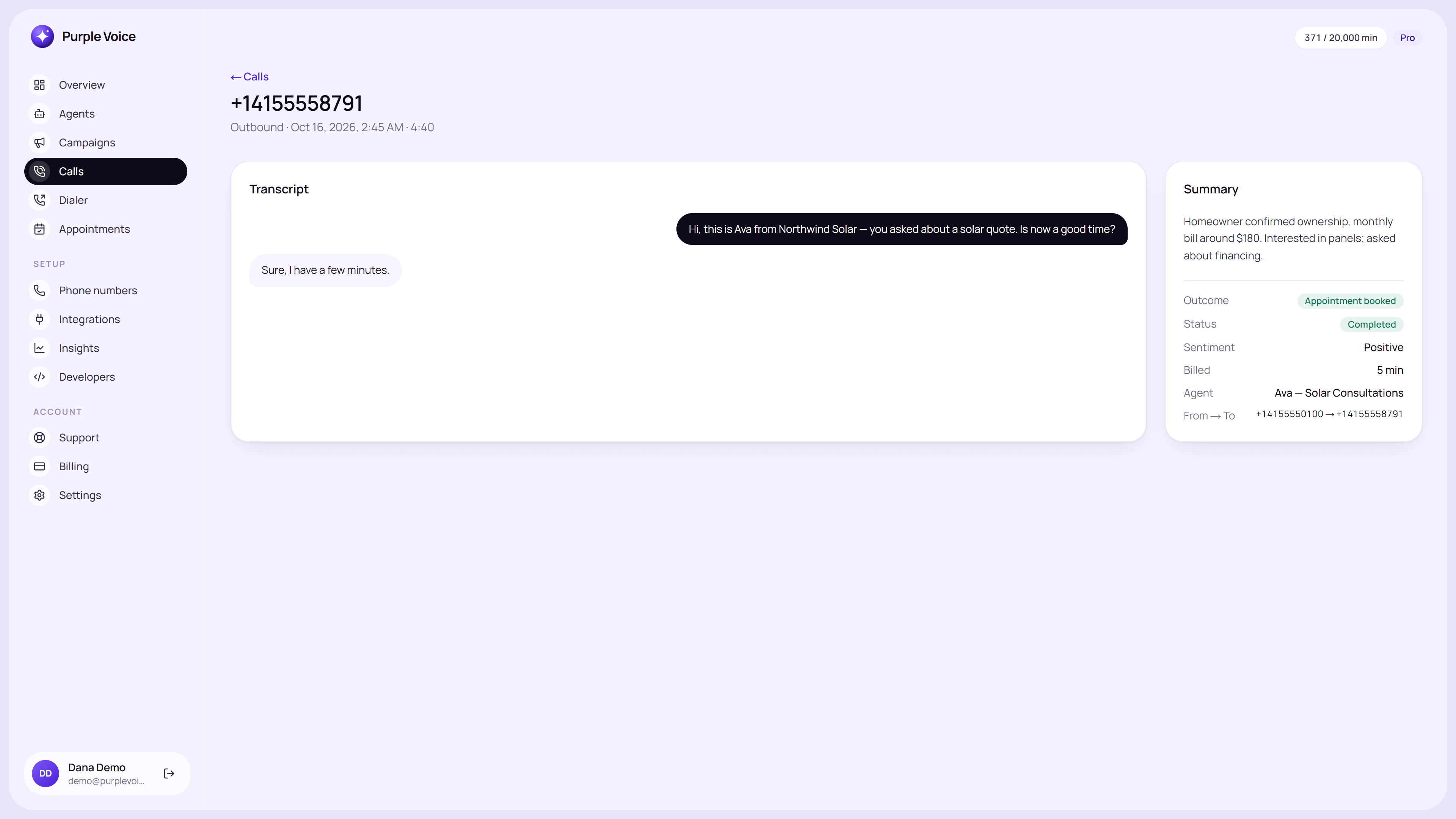 A call detail page with transcript and AI summary, the kind of record a compliance reviewer will want to see.
Compliance and disclosure
Insurance is regulated in nearly every market, and telemarketing rules sit on top of that. In the US, the TCPA and state rules apply to calls using artificial or prerecorded voices. In the UK, PECR and FCA rules apply. Elsewhere, local rules differ. This is general information, not legal advice, so take your own advice before launching.
Practical habits that help in any jurisdiction:
- Tell the person early that they are speaking to an AI assistant.
- Only call people who have a clear connection to your business, such as a quote request or an existing policy.
- Honour do-not-call requests immediately and record them.
- Keep call times inside permitted hours.
- Never make the AI pretend to hold a licence.
See disclosing AI on calls and TCPA and AI voice calls for more.
Keep humans where it counts
A good split is simple. The AI handles: first contact, reminders, scheduling, FAQs about logistics. Licensed staff handle: advice, recommendations, quotes that depend on underwriting judgement, claims, complaints and vulnerable customers.
If a caller sounds distressed or confused, the agent should offer a human and end the AI part of the conversation. A transfer to a live adviser during working hours, with a short briefing, is far better than pushing on. Our piece on warm transfers explains how to set this up.
A note on tone with policyholders
Insurance calls often reach people at stressful moments: a price rise, a life change, a recent claim. Write the prompt so the agent is unhurried, uses plain language and avoids jargon such as "excess" or "indemnity" unless the caller uses it first. Tell it to apologise briefly if a caller is annoyed and to offer a human straight away rather than defending the process. Keep calls short, and never let the agent imply urgency that does not exist. A renewal date is a fact; "you must act today" is pressure. Reviewing a handful of transcripts each week will show you quickly where the tone slips.
Try it
Pilot one narrow flow, such as quote follow-ups for the last two weeks of unconverted leads. Purple Voice has a Free plan with one agent, one number, 100 contacts per campaign and 100 minutes a month, no card, so you can test before involving finance or compliance. Try it at voice.purplerocket.co, and see pricing when you need more volume.
Frequently asked questions
Can AI calling be used for insurance quote follow-ups?
Yes. An agent can call people who requested a quote, check they received it, answer basic questions from your knowledge base, and book a call with a licensed adviser. It should not give advice or recommend products.
Can an AI voice agent sell insurance?
In most places, selling or advising on insurance is a regulated activity that needs licensed people. Use AI for qualifying, reminders and booking, and keep advice, recommendations and binding cover with licensed staff.
How can AI help with insurance renewals?
It can call policyholders ahead of renewal, confirm contact details, ask whether circumstances have changed, and book a review with an adviser. It saves your team the high volume of routine reminder calls.
What should an insurance AI agent never say?
It should never quote a premium it has not been given, promise cover, say a claim will be paid, or describe policy terms beyond what is in your approved knowledge base. Tell it to pass those questions to a human.
Do insurance calls need to be recorded?
Rules vary by country, product and regulator. Many firms record calls and keep transcripts, but you need a lawful basis, notice and a retention policy. Check current rules with your compliance lead.
Which insurance lines suit AI calling best?
High-volume personal lines, such as motor, home and travel, and simple small-business cover are common candidates. Complex commercial risks tend to need an adviser from the first conversation.
- insurance
- renewals
- outbound
- qualification