Guides · September 22, 2026
AI voice agent pricing explained: platform fees, minutes and provider costs
Voice agent pricing comes in three layers that vendors often blur together. Here is how to separate them, estimate a real month, and see how Purple Voice plans fit.

AI voice agent pricing is confusing because vendors bundle different costs into one number. The honest way to compare is to split it into three layers: the platform, the minutes, and the providers underneath. Once you price those separately for a realistic month, most quotes become easy to compare.
The three layers of cost
| Layer | What it pays for | How it is billed |
|---|---|---|
| Platform | The software: agent builder, campaigns, dashboard, integrations, support | Monthly fee, often tiered |
| Minutes | Time the agent spends on calls | Included allowance, then per minute, or all per-minute |
| Providers | Phone numbers and calls from carriers, speech and language models | By the provider, per minute or per use |
Some vendors present a single per-minute price that includes all three. Others show a platform fee and leave providers separate. Neither approach is wrong, but they produce very different surprises.
Per-minute bundles
A single rate per minute is easy to understand and simple to budget when volume is small. The downsides: the rate tends to include a margin on everything underneath, and rates can rise when you use higher-quality models or longer calls.
Platform fee plus provider costs
You pay a monthly fee, get an included allowance, and pay phone and AI providers directly or through pass-through billing. The advantages are transparency and often better value at volume. The downside is that you need to understand what each piece costs.
Seat-based pricing
Less common for voice agents, but you will see it from tools that started as dialers. If the agent does the calling, paying per human seat can be a poor fit.
What actually drives the bill
A few things matter more than the headline rate.
- Call length. A 90-second qualification call costs roughly half as much as a 3-minute chat. Prompts that waste time on small talk cost real money at volume.
- Answer rate. Ringing and voicemail time may or may not be billed. Ask how unanswered calls and voicemail detection are charged.
- Retries. If each contact is retried five times, a list of 1,000 contacts can mean several thousand dial attempts. Most of those are short, but they are not free.
- Model choice. Speech-to-speech models and cascaded pipelines have different cost profiles and quality. See realtime vs cascaded voice AI.
- Phone numbers and routes. Local numbers, toll-free numbers and international calls have different carrier rates.
- Minimums and overage. What happens when you go over your allowance: automatic overage, a hard stop, or a forced upgrade?
A worked monthly example
These numbers are illustrative, not quotes. Suppose a small team follows up 400 inbound leads a month.
- Average connected call: 2.5 minutes.
- Answer rate: 45%, so 180 connected calls.
- Retries mean about 800 dial attempts, of which 620 go to voicemail or no answer and last roughly 20 seconds each.
Billable agent time: 180 x 2.5 = 450 minutes of conversation, plus about 620 x 0.33 = roughly 205 minutes of ringing and voicemail, giving about 655 minutes in total.
Now compare two illustrative price structures:
| Bundled per-minute | Platform plus providers | |
|---|---|---|
| Minutes billed | 655 | 655 against an allowance |
| Platform fee | None | Monthly fee covers an allowance |
| Phone number | Included or extra | Billed by provider |
| AI usage | Included in rate | Billed by AI provider |
| Total | Rate x 655 | Fee + provider costs |
The point is not which structure wins. It is that you can only compare them by putting the same 655 minutes through both.
How Purple Voice pricing works
Purple Voice uses a platform plan with an included allowance of minutes. Phone-number rental and AI usage are billed by those providers, not Purple Voice, and the AI layer is managed by our team for each customer.
| Plan | Price | Agents | Numbers | Campaigns | Contacts per campaign | Minutes per month |
|---|---|---|---|---|---|---|
| Free | $0 | 1 | 1 | 1 | 100 | 100 |
| Basic | $19/mo | 1 | 1 | 1 | 100 | 1,000 |
| Pro | $299/mo | Unlimited | Unlimited | Unlimited | Unlimited | 20,000 |
| Enterprise | Custom | Custom | Custom | Custom | Custom | Custom |
Free includes appointment booking, call summaries and one integration, with no card needed. Pro adds webhooks, API access, insights, priority support and advanced automations. See the live pricing page for current details.
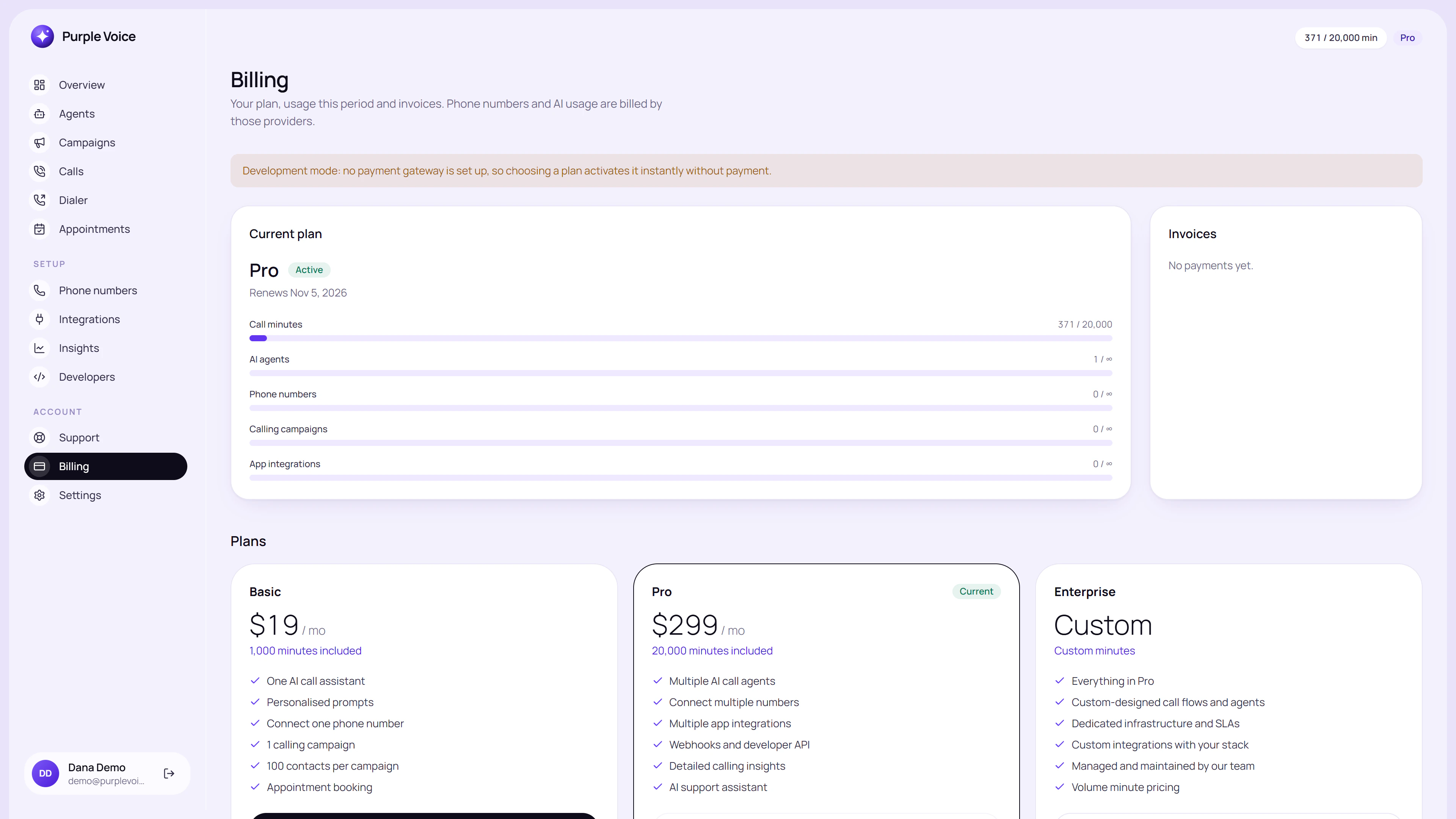 The billing page in the dashboard, where you can see your plan and usage.
In the example above, 655 minutes would fit inside Basic's allowance, and the providers' charges for numbers and AI would be on top of that, from the companies that provide them. Your own invoice will vary with your providers and volume.
Questions to put to any vendor
Before you sign, ask each vendor the same short list, and write down the answers.
- What is the cost of a 3-minute connected call, all in, including phone and AI usage?
- How are unanswered calls, voicemail and failed connections billed?
- What happens when I use all my included minutes mid-month?
- Can I see usage by day, so I notice a runaway campaign quickly?
- Can I cancel or downgrade without a penalty, and do I keep my transcripts?
Vendors that answer these plainly are usually easier to work with later too.
Hidden costs to ask about
- Setup, onboarding or "implementation" fees.
- Charges for extra phone numbers or agents.
- Overage rates and what triggers them.
- Costs for recording storage and retrieval.
- Fees for integrations or API access.
- Minimum commitments, annual contracts and auto-renewals.
- Whether failed calls and ring time count as minutes.
How to estimate your own month
- Estimate the number of contacts you will dial.
- Estimate the answer rate. Be conservative. Many teams find it is lower than they hoped.
- Estimate average connected call length, from a pilot if you can.
- Add ringing and voicemail time at a lower weight.
- Multiply by retries.
- Price the total minutes against each plan and each provider.
- Add 20% headroom for experiments and test calls.
The AI calling ROI calculator and the guide to AI voice agent ROI turn this into cost per booked meeting. If you are weighing a self-built system, build versus buy compares the costs, and best AI calling software gives a scoring sheet.
Try it
The cheapest way to learn what your calls cost is to run a small pilot. The Free plan gives you one agent, one number and 100 minutes a month with no card. Start at voice.purplerocket.co, run test calls on your own phone, and check the usage before you pick a plan.
Frequently asked questions
How much does an AI voice agent cost?
It depends on call volume, call length and how the vendor bills. Costs combine a platform fee, usage minutes, and charges from phone and AI providers. Pricing a realistic month of calls is more useful than comparing headline per-minute rates.
What is the difference between per-minute and platform pricing?
Per-minute pricing charges for each minute of calls, often bundling everything. Platform pricing charges a monthly fee with an included allowance and separate provider costs. Which is cheaper depends on how many minutes you use.
Does Purple Voice charge for phone numbers and AI usage?
No, those are billed by your phone provider and the AI provider rather than by Purple Voice. Purple Voice plans cover the platform and an included number of minutes.
Is there a free AI voice agent plan?
Purple Voice has a Free plan at $0 with one agent, one number, one campaign, 100 contacts per campaign and 100 minutes a month, with booking and summaries included and no card required.
What hidden costs should I look for?
Phone number rental, carrier charges, AI model usage, overage minutes, seat fees, integration fees and setup or onboarding charges. Ask for a total for a realistic month before you commit.
- pricing
- buying-guide
- costs